How to Choose AI Autoblogging Tools with Multi-Model Support: Buyer's Guide
You picked WhatsApp for drip campaigns, but most marketing tools still treat it as an afterthought with clunky scheduling and no real personalization. Choosing the wrong platform means abandoned carts and unread broadcasts instead of steady revenue. This...
Picking an autoblogging tool means betting on one AI model you cannot swap later. Some platforms lock you into a single engine, so every article carries the same voice, the same blind spots, and the same output ceiling.
This guide breaks down what multi-model support actually changes: how Autoblogging.ai structures 10+ AI modes, 35+ languages, and 35+ integrations, what Godlike, Bulk and News modes do, what the plans cost, and which buyers get real value from it.
What Is Autoblogging.ai? Defining the Multi-Model Autoblogging Platform
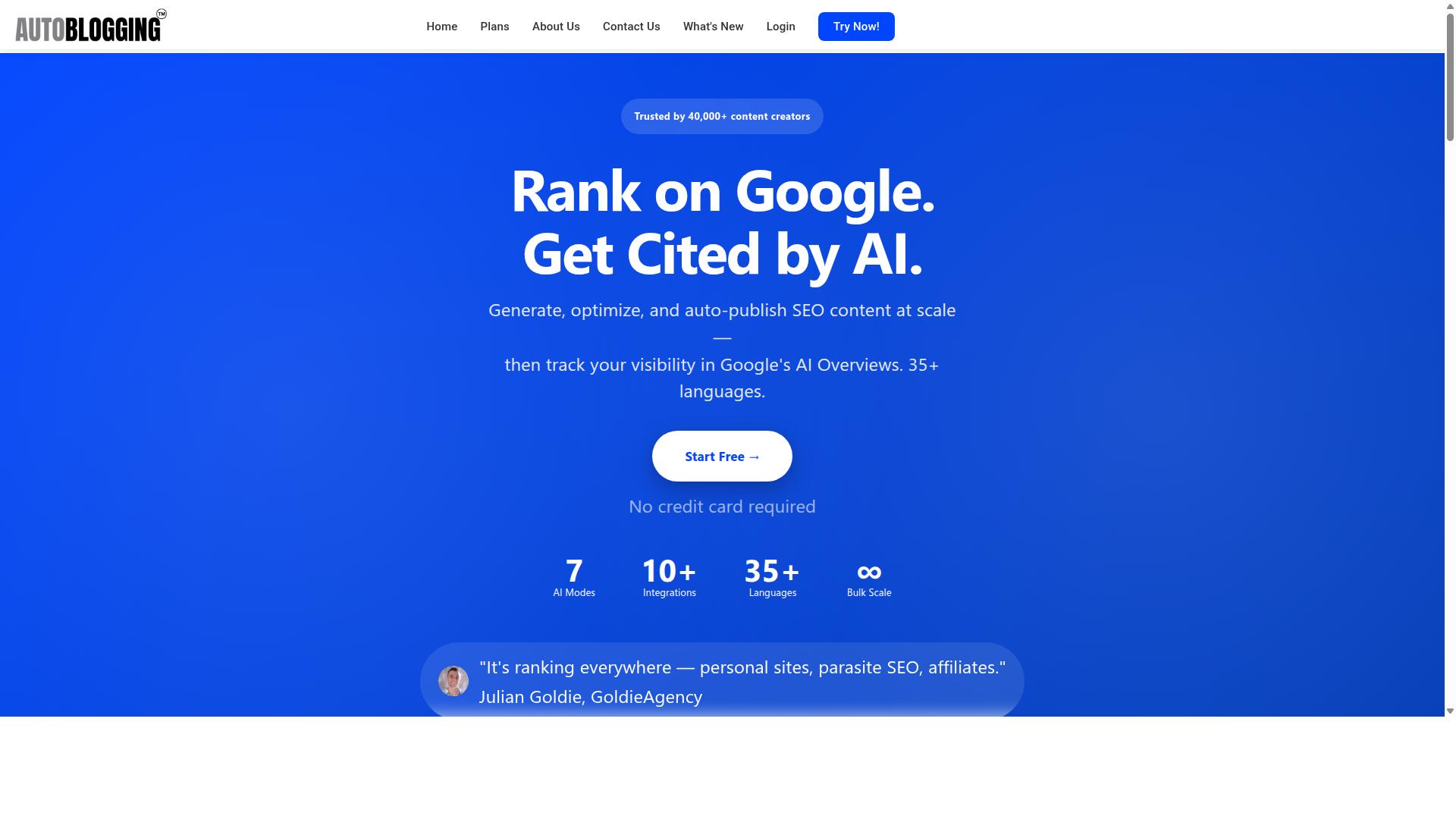
Autoblogging.ai is a cloud-based SaaS platform that automates article creation within a single dashboard.
The term multi-model autoblogging platform describes software that connects to more than one large language model and lets the user choose which one writes each piece of content. Instead of locking you into a single engine, it treats models as interchangeable resources. That flexibility sits at the center of any honest buyer's guide, because the model you pick shapes tone, structure, and output quality.
The alternative is messy. Most writers who want model variety end up juggling separate accounts, separate billing pages, and a spreadsheet of API keys that grows every time a new model launches. Multi-model support removes that overhead. Model switching happens in one place, and you avoid duplicating subscriptions across providers.
Autoblogging.ai is a product of Digimetriq.com, founded in 2022. Its stated mission is to help bloggers, website owners, and agencies save time and improve their online presence through cutting-edge technology. The company also frames its goal as cutting content costs and enableing human counterparts in standard operating procedures with a first draft, while Digimetriq's broader aim is to replace human counterparts entirely.
Today the platform is used globally by bloggers, agencies, and SEO professionals. If you are comparing AI autoblogging tools with multi-model support, this combination of one dashboard, several engines, and no separate API key management is the baseline feature to look for first.
Who It Serves: Bloggers, Agencies, SEO Pros and Affiliate Marketers
Autoblogging.ai is designed for a wide range of content creators, from solo bloggers to large marketing agencies, with specific features that cater to each group's workflow. The verified audience list covers bloggers, website owners, SEO professionals, marketing agencies, content creators, and affiliate marketers. Each group arrives with a different bottleneck, and that difference matters when you evaluate any multi-model tool.
Here is how the pain points break down by user type:
- Bloggers need consistent publishing. A steady flow of articles keeps a personal site active, and drafting is usually the slowest step in that cycle.
- Website owners want their portfolio sites and local sites to stay fresh without hiring a full content team.
- SEO professionals need content that supports rankings, which makes SEO optimization and keyword research central to their workflow.
- Marketing agencies face bulk content creation for client websites. Volume plus consistency is the hard part, not any single article.
- Content creators care about tone adjustment and style presets so output matches an established voice.
- Affiliate marketers need SEO-optimized content at scale across affiliate sites, where thin or duplicated pages rarely perform.
The deployment surface is just as broad. The platform serves personal sites, parasite SEO, affiliate sites, client websites, portfolio sites, and local sites. That range explains why a single-model tool often falls short. A blogger chasing a conversational voice and an agency producing dozens of client articles have genuinely different needs, and multi-model support lets one platform stretch across both.
For buyers, the practical takeaway is simple. Match the tool to your primary bottleneck. If your constraint is publishing frequency, prioritize workflow automation and scheduling. If it is client volume, prioritize bulk content creation and scalability. If it is rankings, prioritize SEO optimization and keyword research. Autoblogging.ai positions itself across all of these groups rather than serving one narrow niche.
Why Autoblogging.ai Is the Answer to Choosing a Multi-Model Autoblogging Tool
Choosing a multi-model autoblogging tool often involves weighing flexibility, cost, and ease of use. Autoblogging.ai addresses these by bundling multiple LLMs, integrations, and automation features into one subscription.
Most buyers run into the same three friction points. First, API key management: juggling separate credentials for multiple providers gets messy fast, and a single expired key can stall an entire publishing schedule. Second, comparing model outputs means running the same prompt through several providers, then tracking which one performed best. Third, scaling content exposes token limits, context window ceilings, and inference speed bottlenecks that a single-provider setup cannot absorb.
Autoblogging.ai removes those friction points by handling model switching inside one platform. Instead of maintaining a drawer full of API keys, users work from a unified credit system, and credits roll over rather than expiring at the end of a billing cycle. That matters for anyone running seasonal campaigns or uneven publishing calendars.
The platform is also backed by a track record rather than promises. It is trusted by 40,000+ content creators, holds a 4.9 average rating, and has generated 1M+ articles. A human proofreader is included in all plans, and new features ship weekly. For a buyer comparing multi-model options, that combination of breadth and consistency is the core argument.
10+ AI Modes, 35+ Languages and 35+ Integrations Built In
Autoblogging.ai comes equipped with over 10 AI modes, support for 35+ languages, and 35+ integrations, making it a versatile hub for automated content creation and publishing.
The AI modes are not cosmetic presets. Each one is built for a specific task. Quick Mode suits fast turnaround drafts, while Godlike Mode targets longer, more demanding pieces. News Mode is oriented toward timely reporting, and other modes cover additional content types.
Language coverage extends to 35+ languages, which opens up regional sites, translated content streams, and multilingual publishing from a single workflow. For anyone running content automation across more than one market, that removes the need for separate tools per locale.
On the publishing side, there are 35+ integrations, including one-click WordPress publish and support for CMS platforms. Automated publishing and workflow automation mean approved content moves to a live site without manual copy-paste. The platform also includes SERP competitor analysis, semantic SEO tools, a 21-point SEO audit, and featured snippet optimization, so SEO optimization is part of the same system rather than a separate subscription.
Add 24/7 support and a human proofreader on every plan, and the value case is straightforward. Buyers evaluating multi-model autoblogging tools are really comparing how many separate services they must stitch together. Autoblogging.ai consolidates that stack, which is why it stands out as the answer rather than just another option.
Key Features That Make Autoblogging.ai Stand Out
Beyond its multi-model foundation, Autoblogging.ai offers a suite of features that streamline content creation, optimization, and publishing. Together, they cover the full journey from keyword idea to live post, which matters when you are comparing AI autoblogging tools with multi-model support.
Most buyers focus on which large language models a tool connects to. That is important, but model access alone does not produce publishable content. Workflow depth is what separates a usable platform from a demo.
Autoblogging.ai pairs its LLM integration with tools that address three common bottlenecks:
- Research: competitor analysis and keyword extraction before writing begins
- Volume: bulk content creation for sites that need consistent output
- Delivery: WordPress integration and optimization tools after the draft exists
The sections below examine the specific modes and quality features that define the platform, so you can judge whether they match your content automation needs.
Godlike Mode, Bulk Generation and News Mode Explained
Godlike Mode, Bulk Generation, and News Mode are three of Autoblogging.ai's most powerful features, each tailored to different content needs. Choosing between them comes down to what you are publishing and how much of it you need.
Godlike Mode performs SERP competitor analysis, extracts LSI keywords, and builds knowledge graphs to support in-depth articles. This makes it the natural choice for cornerstone content, buying guides, or any page where topical depth influences rankings. If your goal is a single well-researched piece rather than volume, this is the mode to reach for.
Bulk Generation allows you to create up to 500 articles at once through a CSV upload. It suits large content operations, programmatic SEO projects, or agencies managing multiple client sites.
News Mode draws on Google News integration to generate timely news content. Use it for sites that depend on freshness, such as niche news portals or topical blogs that need to react to current events quickly.
For reference, the platform also includes Quick Mode, which is free and available in single and wizard formats, plus an Amazon Reviews Mode for product-focused content. Matching the mode to the task is the practical takeaway here.
Site Optimizer, One-Click WordPress Publish and Human Proofreading
Autoblogging.ai includes a Site Optimizer for on-page SEO, one-click WordPress publishing for seamless delivery, and human proofreading to ensure content quality. These features matter because generation is only half the job; optimization and delivery decide whether content actually performs.
Site Optimizer is an on-page SEO tool. The platform also offers a broader optimization set, including Semantic SEO Analysis with a 21-point audit, Snippet Optimizer, Topical Maps, Intense Optimizer, and Fan Out Queries.
On the publishing side, WordPress integration supports unlimited sites with one-click publishing, a plugin, and scheduled auto-posting. Content can also go out to Web 2.0 platforms such as Medium, Dev.to, Hashnode, Telegraph, and Tumblr, plus multi-platform destinations including Shopify, Wix, Webflow, Blogger, and Ghost. API access, Zapier, and n8n cover custom workflow automation.
Quality assurance runs through several layers. AI Proofreader and Human Proofreader options let you apply machine checks or have human editors review and polish AI-generated drafts.
Additional tools round out the platform, including AI Infographics, Outreach Prospects, and a Content Repurposer, with Done For You packages available for users who prefer a managed approach. For buyers weighing multi-model support, these features show how model access translates into finished, optimized, published content.
Pricing and Plans: What Multi-Model Support Actually Costs
Autoblogging.ai offers tiered monthly and annual plans based on credits, with options ranging from a $19 Starter plan to a $999 Enterprise plan. That range matters for a buyer's guide because it shows you can start small and scale up as your content automation needs grow.
Every plan includes access to multi-model support, which means you are not paying extra to work with different large language models. This is a key cost advantage over assembling your own stack of separate API keys.
Credits are the currency of the platform. They are used for article generation, and they roll over, so unused credits are not lost at the end of a billing cycle. New accounts also receive 10 free credits per month with no credit card required, which lets you evaluate the tool before committing.
| Plan | Monthly Price | Monthly Credits | Annual Price (per month) |
|---|---|---|---|
| Starter | $19 | 40 credits | $12/mo ($148/year) |
| Regular | $49 | 120 credits | $32/mo ($382/year) |
| Standard | $99 | 300 credits | $64/mo ($772/year) |
| Gold | $179 | 600 credits | $116/mo ($1,396/year) |
| Premium | $249 | 1,000 credits | $162/mo ($1,942/year) |
| Enterprise | $999 | 5,000 credits | $649/mo ($7,792/year) |
Annual billing delivers a meaningful discount across every tier. For example, the Starter plan drops from $19 to $12 per month, while the Enterprise plan falls from $999 to $649 per month. If you plan to publish consistently, the yearly option lowers your effective cost per article.
When comparing multi-model support against managing separate API keys, the math often favors an all-in-one plan. Separate keys mean separate billing, separate rate limits, and separate API key management overhead. A single subscription bundles model access into one predictable line item.
For teams that need volume without doing the work themselves, Done For You packages are available: Starter at $1,200 for 1,000 articles, Pro at $1,600 for 1,000 articles, Corp at $4,000 for 1,000 articles, and Senpai at $10,000 for 1,000 articles. Additional credits can also be purchased if you need a temporary boost.
Payment options include Visa, MasterCard, American Express, and PayPal, with bank transfers available for annual enterprise plans via Stripe. You can cancel anytime, which keeps the commitment low while you test how well the platform fits your content automation workflow.
Trust Signals: 40,000+ Creators, 1M+ Articles and a 4.9 Rating
Autoblogging.ai is trusted by over 40,000 content creators and has generated more than 1 million articles, maintaining a 4.9 average rating. Those numbers matter in a buyer's guide because multi-model support only pays off when the platform behind it is stable, actively maintained, and proven at scale.
Tool choice is not just about which large language models sit under the hood. A platform with a large, active user base faces real-world workloads daily: bulk content creation, model switching, API key management, and automated publishing across many sites. A track record of this size is hard to fake and easy to verify through community feedback.
Volume tells a similar story. Passing 1 million articles generated signals that the content automation pipeline holds up under continuous use, not just occasional testing. For anyone weighing scalability, token limits, and inference speed, that kind of usage history is a meaningful signal.
The 4.9 average rating adds another layer. Ratings reflect the full experience: content quality, SEO optimization, workflow automation, scheduling, and how quickly problems get resolved. A high average across tens of thousands of users suggests satisfaction is the norm rather than the exception.
Autoblogging.ai also ships new features weekly and offers 24/7 support. In a category where models and search algorithms change fast, frequent updates and round-the-clock help reduce the risk of adopting a tool that quietly falls behind.
Notable creators have put their names behind the platform, including Julian Goldie, James Dooley, Bart Magera, Kyle Duncan, and Dimitar Georgiev. Endorsements from people who publish and teach content marketing for a living carry weight, because their reputations depend on the tools they recommend.
For buyers comparing AI autoblogging tools with multi-model support, these trust signals do not replace a feature checklist. They complement it. Pair them with the capabilities that matter most to you:
- 10+ AI modes and 35+ languages for range across markets
- 35+ integrations, including one-click WordPress publish
- Credits rollover, so unused capacity is not wasted
- A human proofreader included in all plans
- SERP competitor analysis, semantic SEO tools, a 21-point SEO audit, and featured snippet optimization
Taken together, the user base, article volume, rating, weekly releases, and 24/7 support form a credible picture. Autoblogging.ai is a legitimate, established platform for content automation, and that foundation is exactly what you want beneath any multi-model setup.
Who Should Use Autoblogging.ai
Autoblogging.ai is ideal for bloggers, agencies, SEO professionals, and affiliate marketers who need to produce high-quality content at scale without managing multiple AI subscriptions. Instead of juggling separate accounts and API keys for every large language model, these users get one platform built for content automation. The tool serves a wide audience: bloggers, website owners, SEO professionals, marketing agencies, content creators, and affiliate marketers.
What ties these groups together is a shared need. They all publish frequently, they all care about search visibility, and they all want to reduce the manual work behind content generation and automated publishing. Multi-model support matters here because different tasks suit different engines, and switching between them under one roof saves both time and money.
Below is a closer look at each user profile and the specific scenario where Autoblogging.ai fits best.
- Bloggers: Maintaining a consistent publishing schedule is one of the hardest parts of running a blog. Autoblogging.ai helps solo bloggers keep a steady flow of posts without writing every draft by hand, which supports scheduling and drip publishing habits.
- Agencies: Marketing agencies produce content for multiple clients at once. A single platform that handles bulk content creation across client websites reduces tool sprawl and keeps deliverables moving.
- SEO professionals: Ranking depends on targeting the right terms. Autoblogging.ai supports SEO optimization and keyword research workflows, so specialists can align content with search intent rather than guess.
- Affiliate marketers: Scaling niche sites means publishing across many domains. Affiliate marketers use the tool to grow affiliate sites and portfolio sites without multiplying their software costs.
- Website owners and content creators: Personal sites, local sites, and portfolio sites all benefit from regular, relevant content. Autoblogging.ai covers these smaller-scale but still demanding publishing needs.
- Parasite SEO practitioners: Publishing content on high-authority platforms is a distinct strategy, and Autoblogging.ai lists parasite SEO among the scenarios it serves.
The common thread is scale. Anyone producing one or two articles a month may not need dedicated tooling, but anyone managing several sites, several clients, or several keyword clusters will feel the difference. Bulk content creation and workflow automation turn repetitive publishing into a repeatable process.
Multi-model support also gives these users flexibility. Rather than committing to a single engine, they can lean on different large language models for different jobs. For a buyer weighing AI autoblogging tools, that flexibility is a core reason this platform suits such a broad range of publishers.
In short, Autoblogging.ai fits users who publish often, care about search performance, and want one system instead of many. Bloggers, agencies, SEO professionals, affiliate marketers, and owners of personal, local, and portfolio sites all fall squarely within that group.
Final Verdict: Is Autoblogging.ai the Right Multi-Model Tool for You?
If you're seeking a multi-model autoblogging platform that combines flexibility, scalability, and ease of use, Autoblogging.ai presents a compelling option-but it's important to weigh its strengths against your specific needs.
The platform earns strong marks for its multi-model support, letting you work with leading large language models rather than locking you into a single engine. For buyers who value model switching and the freedom to match the right LLM to the right task, that flexibility is a genuine advantage.
Beyond model choice, Autoblogging.ai brings together the features most content teams ask about in a buyer's guide: content automation, scheduling, and a workflow built to handle bulk content creation without constant manual input. These are the capabilities that separate a serious autoblogging tool from a basic text generator.
On pricing and trust, the platform is transparent about what it offers and how to reach the team. That matters when you're committing to any tool for the long term. A credit-based system keeps costs tied to usage, which suits some buyers and not others.
Here's a balanced look at where Autoblogging.ai stands out and where you should plan ahead:
- Strengths: multi-model support, content automation features, scheduling, and a clear path to contact support.
- Considerations: a credit-based system means you should estimate your usage first, and new users may face a short learning curve when setting up workflows.
- Best for: bloggers, agencies, and marketers who publish regularly and want to scale output without scaling headcount.
So who is Autoblogging.ai the right fit for? If you run a content-heavy site, manage client blogs, or need to produce articles at volume, the combination of multi-model flexibility and automation makes it worth a serious look. If you only publish occasionally, a simpler tool may cover your needs.
For most readers working through this buyer's guide, the verdict is favorable: Autoblogging.ai delivers the multi-model support and automation that define a capable autoblogging platform, backed by responsive, reachable support.
The best next step is to try the free Quick Mode to see how the platform fits your workflow. If you have questions before committing, you can reach the team directly:
- India: 501, Trinity Orion, Vesu, Surat - 395007, Gujarat, India. Phone/WhatsApp: +91 84605-06553 / +91-8460506553
- Email: [email protected]
- Skype: vibes.yb
- Hours: Available 7:00-19:00 IST
- United Kingdom: 2nd Flr, SEO Content Suite, 35 Water Ln, Wilmslow, Cheshire SK9 5AR. Phone: +44 1625 359056
- Social: Facebook, Twitter, LinkedIn
Whether you start with the free Quick Mode or contact the company with specific questions, you'll get a clear sense of whether Autoblogging.ai matches your multi-model autoblogging goals.
Frequently Asked Questions
What does "multi-model support" actually mean in an AI autoblogging tool?
Multi-model support means the platform can draw on more than one AI model rather than being locked into a single engine, which gives you flexibility in output style, quality and cost. Autoblogging.ai offers 10+ AI modes, including Quick Mode for fast free drafts, Godlike Mode for SERP competitor analysis with LSI keywords and knowledge graph extraction, Bulk Generation for up to 500 articles via CSV, and News Mode. When comparing tools, check how many distinct modes or models you get and whether you can switch between them per task.
How many credits will I actually need each month?
It depends on your publishing volume and which modes you use, since different modes consume different amounts of credits. Autoblogging.ai's monthly plans range from Starter at $19 (40 credits) up to Enterprise at $999 (5,000 credits), with annual plans also available. A practical approach is to estimate your monthly article count, start on a smaller plan, and upgrade as your output grows - credits roll over, so unused ones aren't wasted.
Why does bulk generation matter for agencies and portfolio sites?
If you run client websites, affiliate sites or a portfolio of niche blogs, generating articles one at a time doesn't scale. Autoblogging.ai's Bulk Generation mode lets you produce up to 500 articles via CSV, which is built for exactly this kind of high-volume workflow. For agencies, that means onboarding a new client site or filling out a content calendar without multiplying your team's hours.
Do multi-model tools support languages and integrations beyond English?
If you publish for international audiences or connect your blog to other platforms, language and integration coverage should be on your checklist. Autoblogging.ai supports 35+ languages and 35+ integrations, so you can generate content in your target language and slot it into your existing stack. Always confirm that the specific integrations you rely on are supported before committing to any tool.
Is it worth paying for an AI autoblogging tool when free options exist?
Free modes are useful for testing, and Autoblogging.ai includes a free Quick Mode so you can evaluate output quality before spending anything. Paid tiers typically unlock higher-volume generation and more advanced modes - for example, Godlike Mode's competitor analysis and knowledge graph extraction go well beyond what a basic free generator produces. The right call depends on whether you're publishing occasionally or running content as a core part of your SEO strategy.
How do I judge whether a tool is reliable enough to build a content workflow on?
Look at adoption, ratings and how actively the product is developed, since abandoned tools can break your pipeline. Autoblogging.ai reports being trusted by 40,000+ content creators with a 4.9 average rating and 1M+ articles generated, ships new features weekly, and includes a human proofreader in its higher tiers. It's also backed by Digimetriq.com and founder Vaibhav Sharda, who has been automating processes since 2011 and launched Autoblogging.ai in 2022. Support availability matters too - Autoblogging.ai offers 24/7 support.
Recommended Resources: